Siqi Wang, Sorbonne University, GeePs

Siqi Wang is currently an Associate Professor with Sorbonne University, Paris, France. He received the B.S. degree from the Huazhong University of Science and Technology, Wuhan, China in 2012, the M.S. degree from the University of Paris-Sud, Orsay, France, in 2014, and the Ph.D. degree from the University of Paris-Est Marne La Vallée, Champs-sur-Marne, France, in 2018. He was a Researcher Fellow with the Group of Electrical Engineering-Paris (GeePs), Centralesupélec, Gif-sur-Yvette, France, from 2018 to 2019. He was a Researcher Fellow with the Chalmers University of Technology, Gothenburg, Sweden, from 2019 to 2021. He has authored or coauthored more than 60 journal articles and conference papers. His research interests include neuromorphic circuit modeling, energy-efficient optimization, digital predistortion, and massive multiple-input multiple-output (MIMO).
Laboratory Génie Electrique et Electronique de Paris (GeePs)
Electronics Division
The division has comprehensive expertise in the fields of modeling, design and characterization of electronic components, devices and systems.
The skills thus cover the development of:
- new transducer structures and innovative components with increased performance,
- analog electronics (physical/analog interface, analog processing in low frequency (LF) or radio frequency (RF)),
- mixed electronics (high-resolution or high-speed analog-to-digital conversion),
- digital electronics (algorithm/architecture matching with a multi-target approach involving FPGA, CPU, GPU and ASIC).
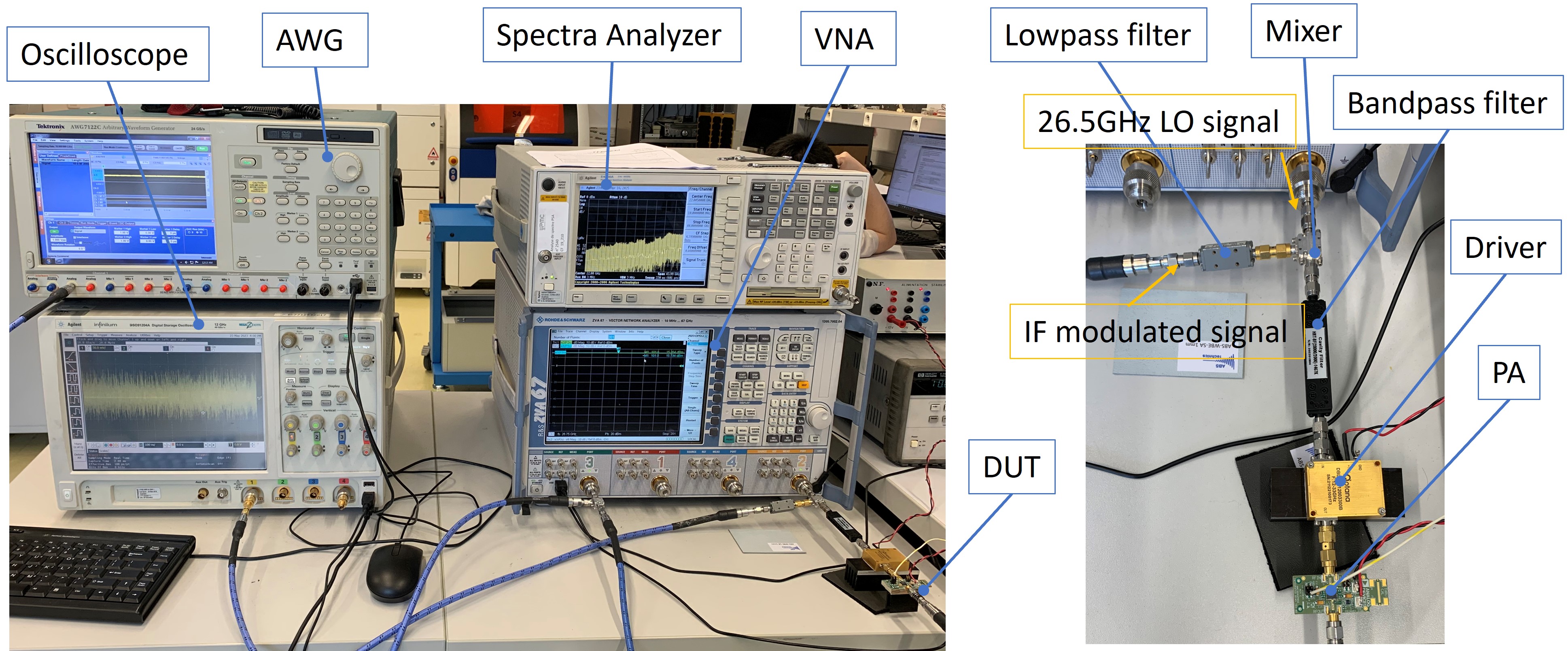
The testbench for RF system measurement is set up in the lab.
The DUT is a HMC994APM5E PA following a driver which is DBLNA312003300B PA. The DUT operates in the DC-28~GHz band. Its nominal gain between DC-28 GHz is 14 dB and the saturated output power is 29 dBm. The supply voltage is 10 V.
We generate a 5G NR signal with 400 MHz bandwidth at the baseband in the PC workstation and feed it to an Arbitrary Waveform Generator (AWG) at 10 GHz sampling frequency. The AWG generates the stimulus at an intermediate carrier frequency of 1.5 GHz which is then upconverted by a mixer with 26.5 GHz local oscillator (LO) signal generated by the vector network analyzer (VNA). A bandpass filter of 27-29 GHz is set up in front of the DUT to remove the unwanted harmonics produced by the mixer.
The PA output signal is downconverted by another mixer to 1.5 GHz. The intermediate frequency signal is then captured by an oscilloscope with sampling rate at 10 GHz and is fed back to the PC workstation for postdistortion processing.
Testbench for DPD via Over-the-Air (OTA)
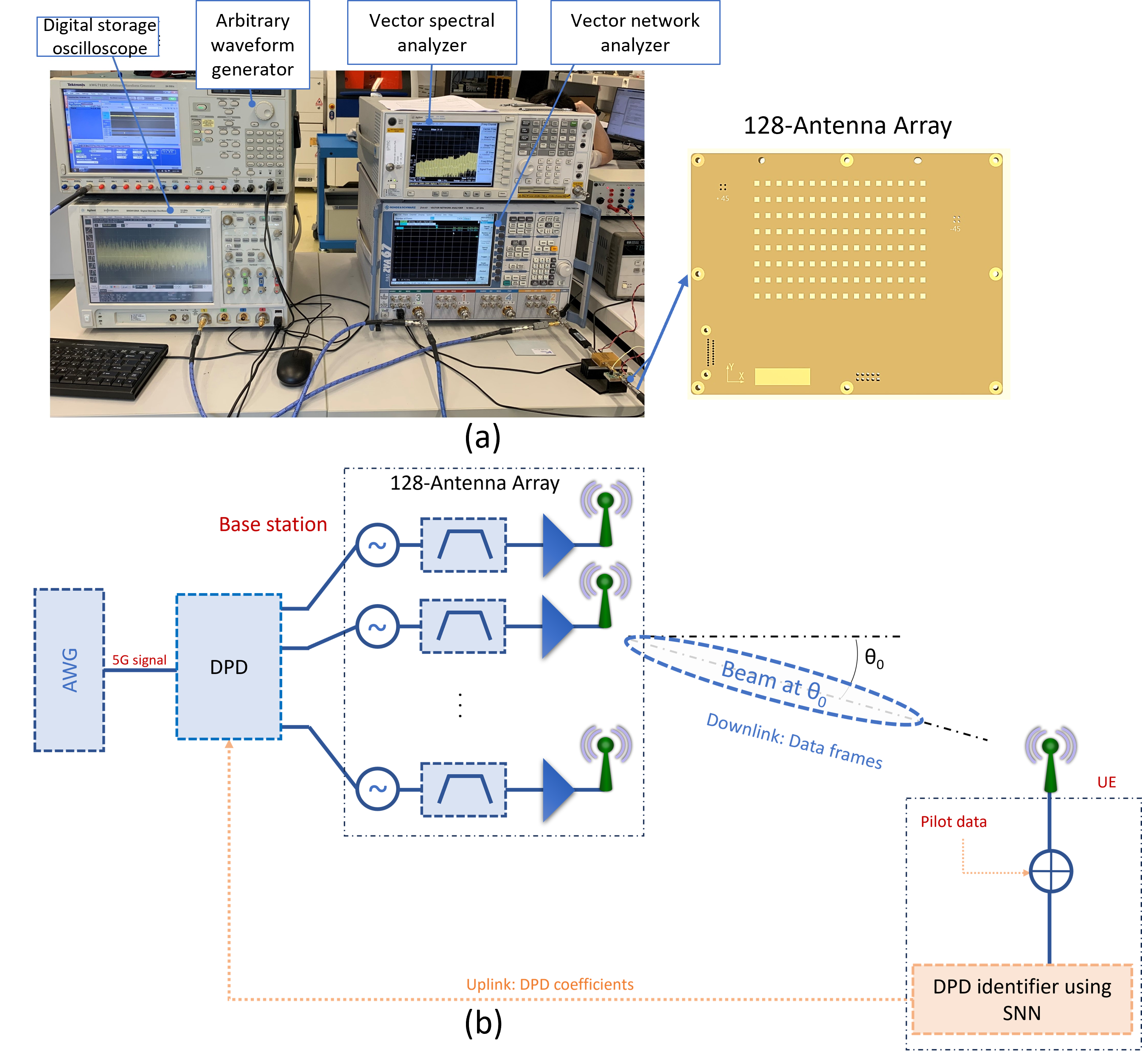
Linearizing the PA in a base station of 5G and beyond telecommunication network has an important requirement on energy-saving and resource optimization. The challenge to be addressed is how to obtain a well-defined DPD block using low computational resources and to avoid large amount of data processing in the case where a real massive antenna array is deployed in experimental measurements. The emerging technique of the spiking neural networks (SNN) has shown a great potential in reducing power consumption and in variety of biomimicry for AI. Low power SNN can be embedded on user equipment (UE) for DPD model coefficients estimation tasks, which finally provide only the necessary parameters instead of the full segment of received samples to the base station for the DPD model training. In this project, we have worked on SNN to compute the DPD coefficients, which establishes an efficient wireless AI network to enable linearizing the PA and phased antenna array with high energy efficiency. The heterogenous information collected by UE is pre-processed in embedded small-scale SNN.
The test bench for the system is illustrated in Fig. 2. The SNN algorithm has low complexity to be implemented on UE side. The 5G signal predistorted by the DPD will be load from the PC to the arbitrary waveform generator (AWG) to generate the RF signal. It is then upconverted by local oscillation generated by the vector network analyzer (VNA) to 27 GHz for the 128-antenna array. The antenna array can transmit and receive signals using Time Division Duplex (TDD). The vector spectral analyzer (VSA) and the digital storage oscilloscope (DSO) convert the feedback RF signal into baseband digital signals for further SNN computing.